Showing posts with label call of cthulhu. Show all posts

Friday, 25 October 2013

Good Guy Cthulhu 5


Tuesday, 1 October 2013

Good Guy Cthulhu 4


Tuesday, 24 September 2013

Good Guy Cthulhu 3


Wednesday, 18 September 2013

Good Guy Cthulhu 2


Monday, 2 September 2013

Good guy Cthulhu


Tuesday, 25 December 2012

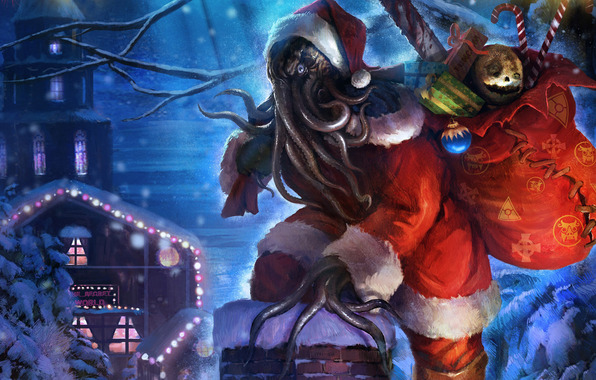
Christmas Greetings to All

Hope you get many of these


not merely over Christmas but in the year to come. I'd like to thank everybody who follows this blog, everyone who drops in to look at the succubus picture (more popular than hot elf chicks or wild boars) and your nearest and dearest. I hope you've all been good this year because if you haven't....


Friday, 21 September 2012

The Thirty Nine Steps by John Buchan

Think you know the story? Think again. 

She's not in the book


This never happens in the book


Sorry, no Forth Bridge hidey bits in the book


Forget all about Mr Memory


Many people will be familiar with this one via the many cinematic or televisual adaptations which seem to come along more often than a new edition of D&D. However, few, if any, have given a faithful rendering of the book and it’s only in the past few days that I’ve actually gone back to source and read the original, which is getting on for 100 years old (in 2015).

Why, I wonder, do they feel the need to adapt it so heavily?  What about the story seems to make it difficult to transpose to the screen?  The book itself is short – around 41,000 words, so its length shouldn’t be a problem. It’s fast-paced with barely a let-up in the action, so fitting it in to 2 hours or so presents no difficulty.

No, what the problem is with the book is its sheer old-fashionedness; it champions values that are sadly out of keeping with the modern world as we perceive it and wish it reflected in our entertainments.  Nobility and self-sacrificing heroism, a rugged masculinity and a lack of sexual content seem, it appears, to make for poor crowd-pleasers.  It did, however, manage to please me, since I took it at face value and cannot really remember clearly the cinematic adaptations.

To be honest, whilst enjoying the yarn (for such it is), I was reminded for the most part of a Call of Cthulhu scenario in the Keeper is intent on giving the players the fright of their lives whilst never really intending to kill them. In fact, the whole book could serve as an object lesson in how to survive whilst on the run in the aforementioned game, since it is set in 1914, barely a decade or so before the time during which many Keepers set their adventures. Merely substitute ‘sinister plotters’ for ‘sinister cultists’ and you could probably run this one.

Of course, there are, it is freely admitted, colossal contrivances that conspire to make the story work. It’s a yarn, as I’ve already said. The pace manages to overcome the disbelief that may rear its head at certain points and if you read it in the spirit in which it’s written, the enjoyment is heightened. There’s also a rather abrupt ending and some dialogue that might be read as a ‘comedy Scottish accent’ although since Buchan was Scottish, I must bow to his inestimably superior knowledge.

As a glimpse into another time, another world and another set of values to which we may well glance with wistful nostalgia from time to time, especially when confronted with the less than savoury aspects of our own time, this book stands as a very good example.

Friday, 12 August 2011

Running a Call of Cthulhu pbem – The Sixteenth and Final part

Call of Cthulhu is a dark and dangerous game and not the sort of thing you’d associate with humour. However, there is room for levity of a sort within the game. I found two sources; the first was direct, in which I would frequently title e-mails with groan-inducing puns and the second was indirect, in which humorous situations arose out of play. The chief amongst these, and one that is remembered even now was Alessandro Mancini’s attempt to seduce the pretty young librarian in Brattleboro and thereby gain access to the secrets that a locked bookcase might supply. However, his internet dice rolls were so bad that the seduction (complete with impromptu poetry reading) backfired catastrophically, an incident that was memorably chronicled by Dungeonmum on her blog.

Whilst these two types of humour are perfectly acceptable since they do not undermine the general atmosphere of gloom, horror and dread, I don’t think that it’s a good idea for the Keeper to deliberately crowbar in situations or characters that are intended to be either ridiculous or comic relief. Whilst I don’t go as far as James Maliszewski in my dislike of things that vitiate the sense of cosmic horror and eldritch darkness that should permeate a game of CoC (I have a cuddly Cthulhu on my bookshelf) I have referred in previous posts to the efforts a Keeper should make to ensure that the atmosphere of a game is as close to that evoked by Lovecraft as possible. Laurel and Hardy or an attack by Mr Stay Puft just don’t fit into that.

And finally; some weeks ago, it was discussed in the comments section that it would be a good idea for some guidance on the best ways for players to participate in a pbem. I asked my players and Dungeonmum came up with the following sage words of advice.

Dungeonmum's Top Tips:
Talk to as many NPCs as you can, even the boring looking ones. If the information they provide doesn't help your investigation it will enrich your gaming experience, and maybe provide you with allies (plus it will give the keeper some work, as if they don't have enough already!)

Remember that you can do anything - don't worry too much about 'permission' - allow your PC to behave according to their personality, situation and the social constraints of the era and culture in which they are set, but don't be constricted by what you think is the 'correct' (in terms of gaming, rather than morality) thing to do.

Yes you can split the party. In tabletop this is harder to maintain but simply done in pbem. If something a co-player wants to do doesn't grab you or time is of the essence and you need to gather more information on more fronts, follow your nose (but be polite about it).

Remember that you are part of a group, so when you return from your forays and the keeper says to intercommunicate - keep your colleagues abreast of everything that you have learned, and try to do it in character, rather than info-dump (see next point). I made the mistake of forgetting to share something that I had learned (or assuming the others already knew, there are a lot of emails that go chugging back and forth - see other point below), but it turns out they didn't. Information that could have been critical.

Talking in-character is fun, I to like write my emails like fiction to distinguish between me the player and my PC. In pbem I do a lot more role-playing than table top (which frankly I always find rather nerve-wracking). My PC is a troubled alcoholic who is frequently witness to disturbing events so I can easily portray her trembling hands, nervous stares, chain-smoking and even signs of her addiction. Apart from checks and other die rolls most of the pbem exchanges are done in-character.
Pbem involves a lot of emailing of course. Set up a folder for it especially in your inbox, maybe even get the relevant addresses to send directly there. The chances are you will need to search for some vital clue that turned up months ago (another beauty of pbem, you are your own stenographer), and you don't want to go trawling through a choked inbox or even (horror!) delete stuff that could be useful later.

Well, that’s it for my guide to running a Call of Cthulhu pbem. I hope that this series of posts has either inspired you to get involved in an e-mail campaign or at the very least kindled (or rekindled) your interest in what must be one of the very best role playing games of all time.

Friday, 29 July 2011

Running a Call of Cthulhu pbem Part Fifteen

A brief word on handwaving, the definition of which I am taking as “Not burdening your players with the tiresome bits of reality…”

A pbem takes a long time to play. I think my first adventure took about eight months to cover from Saturday lunchtime to Monday evening. Although subsequent adventures have moved perhaps that little bit faster, it’s still a long process, even if only the essential stuff is included. It stands to reason therefore that anything that slows the process down should be looked at closely and its necessity questioned. We’ve already covered the amount of detail a Keeper should include, but what I’m talking about today consists mainly of the moments at which you decide to say “Yeah, okay, I’ll wave that one through and we’ll move on…”

If it breaks a logjam or moves the game forward and is fair to the player concerned and the Keeper can explain the justification so that it appears fair to the player(s) concerned, it will (or at least it should be) generally accepted.

Handwaves should be considered a limited commodity – if the Keeper starts to use them too liberally, it can give the impression that the action is being circumvented or that, again, player involvement is being restricted.

The perspicacious Keeper should be able to spot when a handwave is required. If you’ve got your finger on the pulse of the adventure, the sputtering sound as the flow starts to stall is a good sign. Similarly, a good degree of player enthusiasm for the process should indicate that now is not the time to skip to the next scene.

I’m just going to mention, as we are getting very near the end of this series now, something that also comes at the end – of the adventure itself.

There is a temptation, possibly born of those five-minute segments at the end of shows, to go through what happened and clear up any loose ends. However, this is probably not a good idea in Call of Cthulhu.

Therefore, my advice is not to do an end of adventure reveal if the adventure is being played as part of an ongoing campaign. The party may never visit the mysterious Majestic Hotel again but unless you’re not going to use those characters again, ever, then keep the lid on what really went on. As we journey through life, we can be fairly sure that we don’t know everything about things that happened to us. Some events in our life are mysteries or just downright baffling. It should be thus in Call of Cthulhu. The party may have overlooked something that the keeper can go on and use in a later adventure set in that same world – but if he spills the beans about what the party missed, that’s an opportunity wasted and it makes the party privy to information that they would not otherwise have learned.

Next time – a bit of humour in an otherwise bleak, horrifying and eldritch world and some valuable insights from my players on sandbox Call of Cthulhu

Friday, 15 July 2011

Running a Call of Cthulhu pbem Part Fourteen

Old School gamers have had it repeated so often that they can recite it in their sleep – never split the party. In combat-based games like D&D, the reason is obvious – half a party is half as likely to be able to fight off something that a whole party could probably beat. This, however, is usually not the case in Call of Cthulhu. No matter what size the party, running into something eldritch and monstrous is usually a TPK unless the investigators have something powerful on their side. Similarly, one person can die just as easily as five or six if they encounter a Shoggoth.

So, if it doesn’t matter what size the group is, there’s no reason not to split up and cover more ground (to paraphrase Scooby Doo). Indeed, the investigative focus of a good CoC game almost demands that the party breaks up into smaller groups or individuals in order to gather evidence and follow up leads. If the Keeper is doing their job right, there will be more leads than one party can cover on its own – the division of labour is not only advisable but essential if the investigators are going to stand a chance of acquiring enough information to stay alive (and that is the virtue of information, after all).

The format of a pbem makes it very easy to split the party up, in a way that can’t really be done with a tabletop game. No sending players out of the room and running the risk of having them listening at the door.

However, if the party does split into two or more sub-groups, it is very important that track be kept of time. One part of a split party should not be allowed to get too far ahead, since actions taken by the other part of the party may have an effect on them and it gets very confusing (and prejudicial to the atmosphere of the game) if time keeps having to be rewound in order to slot things into their correct chronological place. A general rule is to allow one sub-group to carry out actions that take it perhaps half an hour into the future and then concentrate on the other sub-group. Two sub-groups can be run simultaneously in pbem and be unaware of the activities of each other.

The players should, of course, be encouraged, in the tradition of the old public information films to let their fellows know where they are going. An investigator that does not call in on time can be assumed to be either dead or captured. With the second possibility, their rescue may be effected but even if they are dead, their remains, such as they are, may be able to tell their fellows something of importance.

Many CoC scenarios open with a social gathering of some nature. It’s difficult to administer these face-to-face as the odds are likely – as we have already mentioned – that the other players are listening in to the conversations that the Keeper is having with one particular investigator. There’s also the problem of putting on accents and strange voices, but that’s a matter of personal taste for each individual Keeper. Pbem means that the same e-mail can be personalised for each player. This makes it relatively easy for three characters to be talking to three different people in the same room and still feel that they are the focus of the Keeper’s attention.

Next time – when to handwave.

Friday, 8 July 2011

Running a Call of Cthulhu pbem - Part Thirteen

It’s been said on better blogs than mine - unless there is a very good reason to say No, say Yes but ensure that players face the consequences of their own actions.

As we’ve seen in weeks gone by, something that the players do may take the scenario off in a totally unexpected direction and - as we have also seen - this is a good thing. It’s also nothing to be scared of, since, if you’ve been following my earlier guidelines, you’ll only be two steps ahead of the players and won’t have invested hours of your valuable time in devising something that the players just don’t seem to want to try. Will you?

If you have, by some oversight, detailed the next six months of the campaign and feel that this work should be appreciated by your players, then it’s always possible to have the new divergence feed back into the original plotline at a certain point. But for goodness sake, be subtle! In fact, subtlety is, I think, one of the key attributes of a Keeper – if the players don’t notice that something has happened plot-wise, you’ve done your job. Nobody likes being told what to do (if they do, they play Adventure Path D&D, not CoC Sandbox) and those who don’t like it and realise it’s going on are going to get a little bit upset about it. They may even start to deliberately choose against expectations, which can make the adventure a little…hectic.

In the end, it’s all about player choice. I am aware that you, the Keeper, know all things and realise that behind the doors of that abandoned warehouse in Brooklyn is a Shoggoth that is going to turn the party into something resembling a Jackson Pollock but going through those doors is the player’s choice and their right as well. Provided that you have given them clues as to what awaits them, their decision should have been an informed one and if they’ve decided to go ahead anyway, that’s their lookout.

That having been said, nobody likes a TPK but if this was D&D and the characters were nudging 6th with a good chance of levelling up and had been playing the same characters for nigh on a year, the degree of personal distress at their demise would be a good deal higher than it might be if their investigators came to a sticky end after the same length of time playing (and adventures in pbem CoC can run for months). Players of CoC know (or they should know) what the game is like, what is likely to happen and more or less how it is going to happen. If they don’t know, they should be advised pretty quickly, preferably at the recruitment stage to give them the chance of playing something a little bit less…dangerous.

It’s a common complaint about New School adventure paths and such like that in order to keep them on track, the GM has to overrule the results of player choice at certain times. The problem with overruling player choice is that it effectively invalidates any input that the player has and disenfranchises them. A choice of one option is no choice at all. And one of the most common phrases in RPGs is “What do you do next?”


After a while, even the most enthusiastic player is going to get a little hacked off with having their avenues of choice closed down. Soon, the light of fun will go out of their eyes and one of two things will happen – either they’ll become a sullen participant, going through the motions and looking for a way of sabotaging the Keeper’s plans or worse still, they’ll walk.

Yes, players do crazy things but that’s what makes memorable and realistic games. And memorable is what you want. In thirty years’ time, nobody’s going to be talking about the game where everything went to plan and nothing out of the ordinary happened, are they?

Next time – Do Split the Party!

Friday, 24 June 2011

Running a Call of Cthulhu pbem – Part Twelve

Celebrities! You really can’t escape them. Of course, you might have thought you could by playing a role-playing game set in the 1920s but such thoughts are foolish whimsy because they had celebrities back then as well. The big difference between celebrities of the 1920s and today’s rather shallow assortment is that the 1920s type were famous for a reason and, if we can allow ourselves a further leap of reasoning, the fact that we can remember them means they were really famous, not just the wishy washy sort of fame we know today.

Where am I going with this? Simply this; there is a great temptation with historical RPGs (and let’s be honest, that’s what CoC is if you set it in the classic HPL era) to introduce historical figures into the adventure, to have the investigators rubbing shoulders with the great and the good of the roaring twenties. However, this is never a good idea. Remember the Young Indiana Jones series? He was always bumping into famous people and it started to stretch credibility after a while. It also gives any adventure the air of a history lesson, which is not what we’re aiming for (unless you find history lessons a source of cosmic horror)

The Keeper should therefore avoid ‘famous people syndrome’. The likelihood of a party meeting someone famous by chance on the street or even at a hotel or such like is remote and unless you have something very specific in mind for that famous person, keep them out of it. A case in point is the use of people like Houdini in scenarios. It’s understandable – he’s a fascinating guy and continues to entertain us, eighty-five years after his death. But is his inclusion in an adventure really necessary? Could the narrative requirement be filled by someone else? Do you know Houdini well enough to make it convincing? What if one of the other players knows more about Houdini or is a bit more Google-savvy than you? What if Houdini gets killed during the scenario?

And on a more practical note, not having celebrities in your adventure means that it’s one more job lifted from your shoulders. In a game where you’ll be doing a lot of work, both research and administration, not to mention writing, that’s to be welcomed.

A related clichĂ© is the “Before they were famous” syndrome. Picture the scene – it’s 1920 and the party is in Germany on the trail of cultists. They meet a strange artist with a little moustache struggling to make ends meet with his paintings. Lo and behold, they find out his name is Adolf. If the players are feeling malicious, they might contrive to ensure that something nasty happens to poor old Adolf and voila, historical paradox!

"Hey! This guy says if we buy his painting, he'll tell us where the Temple of Azathoth is"

Of course, famous people by their very nature were part of life back in the 1920s and so mentions of famous people can be made; this adds flavour. It’s like writing a book set in the 1960s and not once mentioning a certain four-man band from Liverpool.

Having said all this, I’m now going to contradict myself – well, slightly Fleeting encounters with famous people can be slotted in; they should, however, remain peripheral (either across the far side of a crowd or appearing for only a few moments and playing no further part in the story) and it helps maintain credibility if the famous person in question is only a minor celebrity and there’s a good reason for that person to make an appearance. Take the Grace la Rue encounter in the Majestic adventure – before I started to run the scenario, I’d never heard of her and she only spends about ten minutes in the game, if that. However, it adds a sense of realism and doesn’t break the above rules.

Next time, I’ll be looking at when to say no – and when to say yes.

Friday, 10 June 2011

Running a Call of Cthulhu pbem – Part Eleven

Call of Cthulhu, the monsters notwithstanding, is not a splatterpunk bloodfest of tentacles and slime. It is not hack and slash, nor is it shoot and slash. It’s all in the atmosphere and it’s up to the Keeper to build and maintain that atmosphere. You might think that it’s difficult to do that through the medium of e-mail – after all, unlike their character, the player is in a well-lit room, well-fed and rested, safe and sound. Why on earth should they feel scared when they read an e-mail? And how can the Keeper ensure that they do?

This is where background reading comes in handy. I’m assuming that the potential Keeper has an interest in horror literature, otherwise he’d be playing D&D or Traveller or any non-horror RPG.

By reading, I don’t necessarily mean HPL (although he is, with suitable caveats, an excellent starting point). What the Keeper needs to do is to immerse him or herself in horror literature, and specifically the more psychological variety. I’m including in this film and TV sources as well. A good place to start is the HPL essay “Supernatural Horror in Literature” and seek out the texts listed therein. I’m grateful to this essay because it steered me to such works as Machen’s “The Three Impostors”, which is a splendid read and the works of Algernon Blackwood. M.R James I had already discovered and HPL’s description of his work as “gifted with an almost diabolic power of calling horror by gentle steps from the midst of prosaic daily life”. This description should be ingrained on the DNA of every Keeper because that, in a nutshell, is what they must do.

One of the key words in that description is “steps”. An adventure where the party meets the monster within the first few turns is going to be a very predictable story indeed because the plot has reached its conclusion and once the monster makes its appearance, there are very few places for the story to go – die or run are the two options that come to mind.

The good Keeper can eke out the fear by ensuring that the horror increases in small but significant increments. Matsch’s Law and the German proverb "Lieber ein Ende mit Schrecken als ein Schrecken ohne Ende" (better a horrible ending than horrors without end) are the antithesis of this philosophy. The players should never be in the position that they are certain that they have reached the end. The greater the tension, the bigger the shock when things finally snap.

In the Majestic adventure, the tension builds because the party don’t meet anything specific for a good while but they encounter aspects of the uncanny almost from the word go. There are also stretches of prose that evoke bleakness, isolation and an unspecified menace that cannot be defended against because its location and therefore its threat are unknown.

Another source of inspiration for generating an atmosphere of mounting horror and menace is to look within. The keeper needs to ask “What really scares me?”

Because, at the level of the amygdala, we all share deep-seated fears; evolutionary pressures have hard-wired into our psycho-biological make-up reactions and instincts that we don’t even think about and yet we are fully aware of the effects of those reactions.

A good grounding in those reactions and the ways in which emotional responses are generated can give insight into the way that fear works. Once the Keeper knows how fear happens, he can devise methods to play on those mechanics and increase tension.

Returning to the HPL quote on MR James, the use of aspects of ‘prosaic daily life’ can reap dividends when it comes to making the players edgy or nervous. We all have a psychological comfort zone within which we feel safe and secure. That zone is often filled with the everyday, the normal; things we trust and know are harmless.

But are they? A good trick to pull when invading the players’ comfort zone is the “are they what they seem?” one, where seemingly normal people, places and things are twisted that little bit to suggest there’s something more to them. The players’ minds will do the rest – and this tendency of the mind to fill in the gaps can do the Keeper’s work for him in numerous other instances as well. Research the way that the mind works – hypnagogic hallucinations, paraeidolia, apophenia, sensed presence; it’s a fascinating subject in itself.

We referred, in an earlier instalment, to the need for the Keeper to stay two steps ahead of the party. Now we can see another benefit of this tactic – the party’s reactions can be picked up and used by the Keeper to rack up the tension. Something works particularly well? Use it. Something didn’t quite have the required effect? Ditch it. By a process of evolution, the ability of the Keeper to get under the skin of his players will be honed and a better, scarier, more vivid and immediate experience will be had.

It’s all in the description when it comes to pbem. You may not be HPL, but by reading around, you’ll be absorbing the techniques, prose and ideas that made great horror writers memorable. Look at the stories that really unnerve you (and CoC is about unease and unsettling rather than outright terror) and try to work out what it was that caused this effect. Analyse the techniques the writers used to evoke that experience. Do the same for adventures that you have played in the past and see how the tension was racked up.

Until next time, pleasant dreams!

Friday, 3 June 2011

Running a Call of Cthulhu pbem - Part Ten

Do you like rules lawyers? Of course you don’t. Well, Call of Cthulhu is the game for you. It’s rules-light and atmosphere-heavy and that’s a good thing.

Firstly because, as you can imagine, the fewer rules there are, the less anyone has to nit-pick about. If I flick through my CoC rulebook, what do I see? Character creation runs from page 11 to 16 – that’s it. Five pages. And one of those is an example character sheet. Page 17 to Page 28 is the Game System and Skills. Twelve pages. Up to page 23 is the Weapons and Damage rules, 24 to 28 is the description of the skills and even they are subject to interpretation.

The very basic nature of the rules system for CoC means that players and Keeper can get on with what matters – the adventure. Establishing a protocol for the game before you start can ensure that the players are left in no doubt as to who has the final call on the interpretation of the rules, such as they are. If a dispute situation does arise, the general feeling (at least amongst our group) is that the current Keeper has the last call. It should also be remembered that rules that apply to PCs also apply to the baddies – or at least they should be - so the PCs are not being disadvantaged. If this fact is pointed out the players at the appropriate point, they should be satisfied or at the very least, mollified.

There is a slight downside to the brevity and simplicity of the rules and that is that it places a burden on the Keeper because maintenance of the atmosphere is down to them. If inspiration fails, there are few mechanics that the Keeper can fall back on for support.

However, overall, the CoC game structure and system means that it is easily learnable and indeed can be played without having an encyclopaedic knowledge of the intricacies of the game system. Would that all RPGs were like that. Indeed, a player can start to play immediately after rolling up a character and probably have just as good a time as someone who’s been playing for years, because the fun of the game, the experience of being an Investigator comes from the way that the players and Keeper interact in developing the feel and atmosphere of the game. And it’s the way in which atmosphere can be created that I’ll be dealing with next time.

Friday, 27 May 2011

Running a Call of Cthulhu pbem - Part Nine

Classic Call of Cthulhu is set in the real world but in a time that, with one or two nonagenarian exceptions, none of us remembers. The pace of change has rendered this period as real to us as Middle Earth. What inhabitants of the 1920s accepted as commonplace is now consigned to the history books, to be learned about as just a collection of facts and sepia photographs.

So the Keeper has a challenge similar in vein to that of a Dungeon Master who has to create a living, breathing world that is at the same time our world but fantastical and alien. The Keeper does, however have one advantage over the struggling DM – the world of CoC does exist, or at least it used to and there are copious records to attest to that fact.

Those records are like a treasure trove, packed with facts, recollections and images that have the potential to bring life to what for us is tantamount to an alien world. In my post on sources of information for Call of Cthulhu, I’ve listed a great many sites where these records can be found. Properly used, they are a Keeper’s best friend.

However, the Keeper does have a challenge that the DM does not have to face. If a party of adventurers decide to head off across the river into the wilderness, past the Granite Obelisks and through the Bull Gate into the Forest of Hawks, the DM can be pretty confident that no-one is going to say
“Hang on a minute, it’s not like that there, the Bull Gate is twenty miles further north and the Obelisks haven’t been raised yet”
Yet if the Keeper turns around and tells the players in 1920 that President Roosevelt is travelling into New York on Route 66, he’s laid himself open to challenges in at least three areas (four if he uses an anachronistic car).

If, like most Keepers and players, you know little about the 1920s, there are two options you can adopt. One is to ignore the facts and wing it. Just play the adventure, no-one’s going to notice the errors and if they do, you can shrug and tell them to go and write their own history book. That’s an approach that, with a group of players who share the same outlook, can work. It would be a shame if that were the case, because well-placed details bring a game to life.
The second option is to ladle on the details with a big spoon. Whilst this is all well and good to begin with, the Keeper needs to remember one salient caveat.

Research is like salt. It adds flavour but too much makes you sick.

If I were to ask you to give me an account of your day, you’d probably not tell me the make of your breakfast cereal, the toothpaste you used or the brand of coffee you drank. You’d probably use generic terminology for those things. The degree to which you’d use that vagueness of description would probably depend on how well you thought I knew your life and how much detail you felt I needed in order to make sense of your account.

We probably both live in a western industrialised society and there are things that we take for granted that each of us know. I don’t have to listen to a description of how your car works, or – for that matter – what make it is or its performance details. You might tell me that it takes three hours for you to drive 200 miles but it took longer last winter because of the snow. You might enthusiastically tell me about your favourite TV programme but you wouldn’t give me an in-depth explanation of television itself.

Both the world we live in today and the world of Call of Cthulhu share certain details and it’s those that circumscribe the amount of information we need when running our games. A fact should be considered, weighed and then slipped into the narrative subtly so that virtually no-one notices. And it should only be done once. The players are there to play, not to study 20th century history.

When I put my author’s hat on and work on my fantasy novel, I have an acronym that I use - WANTONWould Add Nothing TO Narrative. This keeps my work focused and free of unnecessary clutter – or so I hope. The same holds true of the description I write for the pbem. Remember that stretching a point to slot something interesting in is fine, but remember that over-stretching causes breakage.

By way of example, I’m including here a long section of my recent pbem, The Majestic Mystery, which gives an idea of the sort of thing I was sending out to players. Everything included is as historically accurate as I could make it, yet I hope the detail didn’t overwhelm the story.


You make your way to the dinner table where Dwight Albert has already taken his seat and has his wallet out. He passes the waiter a $50 bill and sends the man off with an imperious gesture.
He rises as Julia arrives and draws her chair out for her. He shakes the hands of Alessandro and Solomon, less reserved now that he knows who they are with. You note that Alice is seated with the Frosts. Chester Allen and O'Mahony are on a nearby table. A fresh bottle of whiskey has somehow followed them there.

Eyebrows are raised, nevertheless when Alessandro’s choice of guest for the last place arrives at the table.

Daniel Quigley might be good-looking in a saturnine way if he ate regularly and got some sleep. He is twenty-six but no-one would know it. He shakes Solomon’s hand with a less than enthusiastic grip and takes Julia’s hand and kisses it briefly. His handshake for Dwight is rather perfunctory.

Thanks to Dwight’s foresight in buying the waiter, you have more or less the best of everything. He has scrutinised the wine list and suggests a bottle or two of 1904 or 1911 Bordeaux, on finding that the hotel has no 1900, which he describes as an excellent year. For Alessandro, he acquires a White Burgundy 1906 which he believes you would find outstanding.

As regards champagne, he declares that since there were very poor harvests between 1902 and 1909, the champagne riots of 1910 and 1911 and the intervention of the war, he would not recommend drinking it at present.
Quigley is not particularly impressed by this show of largesse. Drawing a long pull on an unfiltered Gitane, he languidly states “I am a friend of the Green Fairy; she is a tender lover and leaves me intoxicated by her verdant beauty”.

He summons the waiter and whispers something into his ear. A few minutes later, a green bottle of Dornier-Tuller Absinthe, a bowl of sugar and a carafe of ice water arrives at the table. He offers the bottle around; Dwight seems less than pleased but is probably too polite to say anything.

[let me know if you are indulging - it's strong stuff. Anywhere from 45-74% ABV; I think this brand weighs in at 68%. Phew! Technically its import had been banned by the US in 1912 so this must be a bottle that the hotel had obtained before that]

Quigley’s love of French culture, he explains, came from a stay in Paris the previous year, during which time he met Gertrude Stein who he describes as “tiresomely ordinary in an extraordinary way” and made contact with the French surrealists, including Paul Eluard, Tristan Tzara and Andre Breton.
“I fear that when it came to true surreality, I found them wanting. They, for their part, found me too disturbing – however, Miss Somersby, I think that you would find their choice of words intriguing, not dĂ©rangĂ© but affolĂ©”
Julia is aware from her time in France that whilst the former means 'disturbing', the latter means 'terrifying'.
“They would have nothing more to do with me. I came home via London and sojourned there for a week or two; whilst I was there, I had the pleasure of meeting two very interesting gentlemen, Charles Bennett and George Jones, who describe themselves as mystics. And of course, I had the splendid good fortune to meet Arthur Rackham himself. I greatly admire his style – are you familiar with it?
If anyone is familiar with Rackham’s style and work, Quigley will spend several minutes comparing favourites.
“Of course” he says “his work is not to all tastes and some find him frightening. He took me into his confidence and told me that he has several pieces for which he was unable to find an exhibitor. No-one dared show them. I resolved to make every effort to see them one day”

Alessandro mentions the fact that Quigley has been working on pictures whilst staying here. The artist affects a moue of embarrassment.
“Signor Mancini is correct, although my doctor would throw up his hands in despair were he to hear of it. I was sent here for complete rest due to a nervous collapse before Christmas but I found that I was wholly unable to remain inactive. This place is utterly conducive to my work – it affect me, drawing out the visions within. I have such dreams as art is made of. Signor Mancini has displayed an interest in seeing my work – I wonder if anyone else at the table might consider a private viewing later, once dinner is over?”

[let me know if you're interested in Quigley's offer]

Regardless of what anyone else says, Dwight is stalwart in his refusal.
“I am not in the slightest bit interested in decadent, nay, degenerate artwork of this nature. I can see you for what you are, sir – a louche dilettante, sucking the life out of the American art world with your morally fraudulent obscenities”
“Obscenities? You are a representative of the society that sent millions to their deaths in barbed wire and mud for a failed vision and you have the gall to talk to me of obscenities?”
Dwight will not sit still for this but nevertheless he remains controlled in his anger. He regales the table with his war service and the battles in which he was a participant in France.
Quigley turns to Julia.
“Miss Somersby, if I have offended and insulted you by my actions at the table, I apologise. In you, I recognise a kindred spirit, a rebel and a fighter against the shackles of society. In honour of your integrity and that alone, I shall provoke no further; might we continue this discussion after dinner?”

[let me know if you reply in the affirmative to this suggestion]

Dinner continues with Quigley and Dwight giving each other frosty glances across the table but remaining restrainedly polite. As dinner ends and the table staff clear away the plates and glasses, there is an announcement.
“Ladies and gentlemen!” calls a young man who Julia recognises as Tommy Milner “I’m pleased to announce that the Green Mountain ballroom is now open for dancing; we have Miss Grace La Rue and Fred Mulrooney backed by Sly and Lefty Fitzgerald. Rudi at the bar tells me he has giggle water aplenty for those who haven’t had enough at their tables.”

Friday, 20 May 2011

Running a Call of Cthulhu pbem - Part Eight

Other People – they’re everywhere. When you pass somebody in the street and barely look at them, they’re Adventure Dressing but when you stop and interact with them, they become NPCs. And of course, without wishing to sound like a certain Justice Secretary, there are different types of NPC, depending on the function that they are intended to perform within an adventure. Some get perhaps one line of description, others have the privilege of an entire stat block plus back story.

That, of course, is the state of affairs in a conventional published Call of Cthulhu adventure. With the less sandbox-oriented game, NPCs need information because they do indeed perform a specific function – either antagonists for the party in which case their conflict potential needs to be quantified so that they can give our hapless heroes a run for their money or as sources of information, in which case both the information that they will be called upon to impart and the conditions under which they will do so have to be detailed so that the party have hoops through which to jump.

Entia non sunt multiplicanda praeter necessitatem, otherwise known as Occam’s Razor is a principle which should hold true in gaming as well as life. I’m taking it to indicate that NPCs should only be detailed as far as is necessary to give flavour to the game and no further.

There are two reasons for this.

Firstly, to do otherwise is making work for a Keeper when it’s not necessary. There’s enough record keeping and information to manage without making any extra. We’ve already discussed only staying two steps ahead of the players and this should hold true for NPCs as well. There really is no need (unless you’re a glutton for punishment) to start working out precise skill distribution for the antique shop owner in Amsterdam if the chances of the party actually meeting him, let alone him using any of the skills you’re writing down are going to be next to nil for the following six months. The point at which an NPC’s skill levels are worked out should be the point at which the party actually meet him or her and they actually use that skill. It may be that some skill slots are never filled, because they’re never called for. That’s fine – the curator of the museum’s Drive Auto skill is irrelevant if he goes everywhere by subway.

Secondly, there is always the danger, unless the Keeper is particularly dispassionate, that if an NPC begins to acquire detail, they may also begin to gain a personality and start to be thought of by the Keeper as more important than they actually are. We’ve all been there – a set of numbers on a page takes on a life and before you know it, you actually care about the NPC. After all, investing in a sheet of paper and some numbers is what the game is all about, so why should it be so odd if the Keeper starts to do it as well? He’s probably been a player too. It happens. Unfortunately, when it does happen, it’s only natural, either consciously or subconsciously, to take steps to preserve the NPC and that runs the very real danger of violating the development of the game.

However, it may be that in the course of the developing adventure, an NPC attaches themselves to the party and starts to play a particular role. If this is the case, the only skills that need setting up are those which relate to the role that they are playing. Again, keep it simple and worry about that which is absolutely necessary. A rough rule of thumb would probably be that skills in their area of expertise would weigh in at 50 – 60% and other skills anywhere from 20 – 30%. That having been said, to avoid the party being outgunned if they take on someone like that, I tend to set weapons skills generally at about 40-50% or so.

I’m now going to discuss an aspect of the pbem which only really applies if, like my group, you use rotating Keepers. When the mantle of Keeper passes to the next person in the group, what happens to the PC that they were playing (assuming that said PC survived reasonably intact)? I’ve worked it that the PC becomes an NPC run by the Keeper but still very much in the style that they operated previously. Of course, this NPC does, in theory, possess access to the knowledge of the Keeper as regards the forthcoming events and secrets that the party don’t have. This is why the now GMPC should be used as a nudger and hinter but always very sparingly. I used my GMPC in the Majestic adventure sometimes to advance an erroneous opinion or point of view to serve as a stimulus for the party to work their way to the correct solution. It takes a certain mental discipline not to turn the GMPC into a Mary Sue, solving problems and overcoming challenges without fail, but such a character played as a fallible, normal, realistic person can add to the feeling of an adventure. If the Keeper doesn’t feel as if they can carry this off, it’s better to have their character go on a sabbatical for the duration of the adventure. They can always return with some tantalising hints about the next adventure – provided the party hasn’t been wiped out in the meantime. And even if they have, there is now one survivor, determined to find out what happened and, if necessary, avenge them. Voila! The perfect hook for the next game!

Next time, I’ll be discussing research – how much is too much and when to stop before an adventure becomes a history lesson.

Friday, 13 May 2011

Running a Call of Cthulhu pbem - Part Seven

One of the main components of a pbem is of course the e-mail system itself. One thing a Keeper is going to have to be prepared for is the fact that the e-mail folder is going to get very big, very quickly. My adventure, which ran from July 2010 to February 2011 had, at the last count, over two thousand e-mails. Even assuming that some of those were duplicates – and I’m pretty assiduous at deleting earlier versions of threads – the total is still pretty big.

Simple e-mails from the Keeper rapidly become threads which can run and run. Strategic deletion of earlier versions of threads is a necessity but beware getting too over-enthusiastic with the delete button – with multiple players may come replies to earlier e-mails that contain important information not held elsewhere and these replies may be mistaken for part of the thread. If your e-mail system allows you to file e-mails into individual folders, it may be a very good idea to allocate each player a folder into which their communications can be put. Of course, even Windows Mail can sort by sender, meaning that finding a particular e-mail is never a wholly impossible task (unless you’ve double-deleted it).

As we’ve previously covered, the e-mail means that individual players can have bulletins updated to their own character’s adventure requirements – if three people are in a room and each is talking to a different person, this is easily handled.

Of course, e-mail is not just words – pictures can be added to the e-mail and this heightens the flavour and atmosphere considerably. Vintage maps, drawings of sinister runes, charms, sigils and the like can be inserted, rather than being described, with the possibility of misinterpretation. Even different typefaces can be used if required to give an authentic feeling to e-mail communication. Handwriting fonts are available for letters, gothic or Olde English lettering for antique manuscripts, something functional and stark for newspaper stories…

And speaking of pictures, I’ve discussed before, in The Links Effect about tracking down photo archives from the period. A Keeper should start to build up a collection of pictures before they start the adventure, preferably whilst doing the research for their adventure ideas. There are a lot of 1920s resource sites out there, some of which I’ve listed on the post referred to, but you may well find others in your trawl of all things eldritch on the net. Save the ones that strike you as useful to a folder somewhere – it’s a bit of work to start with but you’ll soon start thinking “Oh, I could use that for so-and-so who runs the antique shop in Boston…” which is a lot more handy than thinking, several weeks into the adventure “Oh, I wish I could remember where I saw that picture…”

Good categories into which to sort the pictures, and – from personal experience – I found to be necessary are portraits, building interiors, building exteriors, landscapes, transport interiors and transport exteriors, social images (arts, leisure, fashion, entertainment) and miscellaneous ones like foodstuffs, clothing, drinks, etc. You may find that as the weeks go on, you find an image sparks an idea for a future adventure development.

A bit of a short one this week. Next time, I’ll be discussing how to handle NPCs so that they don’t become too much trouble to handle and what to do with the GMPC to avoid them becoming a Mary Sue.

Friday, 29 April 2011

Running a Call of Cthulhu pbem - Part Six

This week, I’m going to be talking about red herrings.

First, however, a very important fact – in a CoC pbem, there are no red herrings.

But how can this be, I hear you cry. Surely red herrings are one of the crucial factors of any investigation-based game? Otherwise, every clue would point to the solution and the adventure would be over before it had begun.

Except of course that in our sandbox model of adventure construction, there is no pre-determined solution and therefore the party cannot be diverted from something that does not yet exist.

All right – let’s redefine the topic of conversation. Let’s call them the alternate possibilities of the adventure. Things that don’t seem to relate to the direction that the adventure is taking and yet, if spotted and followed can lead to what might seem to be a blind alley of investigation.

At every nexus of decision and possibility, there are usually two and often more choices that can be made. A railroad adventure has already made its mind up about which direction it’s taking and therefore which choice is to be made (and rewarded) and which are not to be made (and penalised if taken). Although it might seem that offering the party numerous choices is multiplying the workload of the Keeper, we’ve already seen that by staying a couple of moves ahead of the party and having the reaction time in days rather than minutes, this is not the case. Therefore, the Keeper’s attitude should be not be “I’ll give you a blatantly obviously relevant clue and two or three that clearly have no relevance to the adventure and can therefore be discarded or ignored” but rather “Let a hundred flowers bloom”

Of course, the last thing that a Keeper wants is for the party to be overwhelmed by choice – therefore, a sense of proportion is essential. Perhaps four or five leads that might result in something significant if the party chose to follow them up is fine. This also means that the entire adventure is not stalled if the party encounter a lead that they cannot, either through luck or misapplication, solve or deduce on their own.

It is a thrilling experience, albeit somewhat nerve-wracking to watch an alternate possibility take on a life of its own if the party decides to follow it up instead. A flexible Keeper will be able to flesh those out and be happy with the adventure going in a completely different direction. It may turn out that the adventure in its final form has virtually nothing in common with the direction that the Keeper originally intended. So much the better – it will be an adventure in which the players feel they have an investment of time, effort and imagination (and of course, the Keeper can gleefully point out that if they all perish horribly or end up insane, they have no-one to blame but themselves)

As well as active and immediate alternative possibilities, the Keeper should also toss in references which may have nothing to do with the current adventure but which broaden the game world that little bit more. These might be called displaced adventure opportunities, since they can either be followed at once (if the party feel like it) or noted and kept for later. Such is the nature of sandbox CoC that these references can often take on a life of their own even if they are not taken up immediately. The living nature of a sandbox world means that displaced opportunities will develop and change with time and the adventure a party takes up eventually may be different in many respects from the one that they might have encountered had they acted on the reference immediately. And if the campaign is a multi-Keeper one, a new Keeper may want to pick up an aside in the previous Keeper’s adventure and flesh it out into a full-blown adventure of their own.

Of course, it may be that there are alternative possibilities and displaced opportunities that are never taken up. Such is the way – there’s always more that the Keeper can invent than can be investigated even by the most active (and fortunate) party. That’s fine – they can become a part of the tapestry that makes up the world’s backdrop. Other parties, NPCs and the like may choose to investigate them, becoming either successful investigators or – more likely – horribly mutilated corpses to be encountered by a future band of player characters. All the more affecting if the NPCs were known to the players and with it, the realisation that it could so easily have been them.

"Do the smart thing - let somebody else try first"

Saturday, 16 April 2011

Joshua Hoffine

Do you like macabre and unsettling pictures? Then this link is for you. He's done a series of horror photographs on Pickman's Model and the portfolio is pretty cool too. Don't forget to check out his blog for more details.

(not suitable for your Junior Grognards)

Friday, 15 April 2011

Running a Call of Cthulhu pbem – Part Five

Ever wondered why so many Lovecraft stories involve the protagonist hurriedly writing a scribbled account of his experiences while the eldritch horrors are closing in?

The answer is simple – said protagonist is the last surviving player in the game and the Keeper doesn’t want his adventure to stall. Some unsuspecting soul, probably the doomed one’s nephew or colleague or best friend is going to find that scribbled manuscript waiting for him and think

“Ah nuts, another TPK!”

It’s a truism in Call of Cthulhu that if you don’t run away, you’ll end up dead. Actually, you’ll end up dead if you DO run away if that monster is faster than you. Probably should have started running earlier.

Generally, however, if the Keeper is doing his job right, a TPK should only really happen in Call of Cthulhu if the party is dumb enough not to run away if the signs are bad. If they do all the right things, make preparations, take a truckload of ammo AND run away as soon as the tentacles appear and still die, then something’s wrong with the adventure.

The aim of a Call of Cthulhu adventure is to scare the party witless, give them a hell of a good time while this happens and maybe, just maybe somebody will die if they’re dumb. Setting an adventure up so that even a well-prepared party has no chance is verging towards Killer Keeper territory. If the party doesn’t spot that they had no chance and were doomed from the beginning, they’re going to hang around in KK territory for a long time.

Chances are that a Killer Keeper wants the party to see just how awesome his final set piece showdown is. He’ll have gone to a lot of trouble to set it up (not having read Part Three of this series) and is looking forward to showing everyone his horror chops as he devours, mutilates and generally trashes the hapless band of investigators.

Of course, it might not be that bad. A Keeper might not realise that he should spare the axe if the party has done everything it should have done. In my Majestic adventure, the party (and this is probably the first time I’ve admitted it) never got to see the Big Bad. Encounters with crazy hillbillies (oh, and green slimy tendrils, which was a bit of a hint as to what they might meet later) were enough to persuade them that the hotel should be given a One-Star rating and probably set on fire. In fact, one of them tried to do just that. But when I realised that they were not going to take that final journey into madness and nightmare, I stayed my hand. They were having a great time and I went with the flow. Many parties will look back on the narrow escape that they had and thank their lucky stars that they didn’t turn that corner, open that crypt, read that book. Of course, not having defeated the Big Bad, they won’t regain any SAN points but hey, that’s the price of life!

Another important thing to consider when talking about mortality in CoC is that when designing an adventure, or even sketching it out in a very rough form (which of course you all do now, don’t you, after Part Three?) a Keeper should remember one thing that is certain about life in Call of Cthulhu – anyone can die. And often very easily and very unexpectedly. Yes, the character may have been stupid and yes, it’s a great shame and a tragedy to boot but death is likely. Very likely. So likely in fact that it’s a very bad idea to structure an entire adventure on the assumption that a particular person will survive it or live long enough to carry out a particular task. Or that a particular scenario or instalment of the adventure can only be solved by a particular character’s particular skill. If only one character has the ability to telepathically see through solid objects and you’ve taken this into account when setting up the fiendish death trap in the cellars of Count Morbidius, then that character had better still be alive if the party is not going to be in deep doo-doo in said cellar.

Hanging the entire adventure, or salient features of it, on that particular character being in possession of all their body parts means one of two things – either the adventure is going to nose-dive rapidly after the Grim Reaper has come to call or the Keeper is going to have to move heaven and earth to keep that character alive, and that means taking delivery of a wagon load of fudge. It’s much better to avoid this before it happens.

Okay, I hear you cry, I’ve got a really dumb party and things look as if they’re heading towards a TPK – they’ve not run away or, perish the thought, their Internet dice rolls have gone really badly. What do I do?

Well, if the party hasn’t quite reached that situation yet, I’d recommend that you advise them all to do the ‘doomed investigator’ routine and scribble down their notes on the adventure so far, leaving them somewhere that somebody can find them or mailing them to their back-up character (of which more in a moment)

If they are all in the cellars of Count Morbidius and something has gone very badly wrong, then I would personally handwave the scribbled note phenomenon for just this one instance and advise them that you’ll be adopting it as a house rule next adventure. They won’t have to say they’re doing it, you’ll just take it as read that they are.

Back-up characters – as smart a move as taking a clean set of underwear to an abandoned crypt under Boston. It’s generally a good idea to have said characters tied in to the current characters in some way – colleague, nephew, friend, parish priest, investigative reporter, that sort of thing. Linked but not too closely. This gives the new character, who may (I wonder why?) be coming into the adventure at very short notice an almost instant hook. By the time the adventure has finished, said character will have perfectly legitimate reasons for hunting down the horrors from the Outer Darkness.

Is it a good idea to have a player bring a new character into an adventure that is half-over if his original character has been killed? I’d say it depends on the player – if you know the player and feel sure that he will run that character without using foreknowledge or information known only to his original character (this is assuming that the OC didn’t leave a log of his doings) then fine, there is no real reason why not. Leave a believable amount of time for the new character to appear – not minutes after the OC has hit the ground, torn to pieces by a Byakhee.

The other plus about having a back-up character is that, even if they are never actually needed to step into the breach (or, let’s be realistic here, there is a slightly extended period of waiting for them to do so) they can in effect have a little life of their own. The Keeper can, with all due respect to the player whose character it will be, contribute events and happenings (interesting but not fatal) that the back-up character can experience. They may even write to the current character to tell them about it. That’s what I call pre-emptive hooks. Nothing too strenuous but enough to give them a link to the current party and perhaps a bit of backstory and knowledge that they can dip into if they need it. With the pbem’s miniverse evolving as you play, this is another facet of the bringing to life of the setting – making it all that much more believable and realistic.

Next time, I'll be smelling something fishy - red herrings and how to make the best use of them.